
Image from www.cousteau.org
Happy Birthday to what would be Jacques Cousteau's 104th birthday today! As stated in previous blogs, he was a strong leader in studying our oceans and I am so grateful to be included in the science for Mission 31. I've wanted to study coral reefs since the first grade and am very fortunate to have this opportunity during my first year as a PhD student at Northeastern. With our arrival to Aquarius less than a week away lots of progress is being made to finalize the details for our time down at Aquarius.The past few weeks I have been working on assembling the traps that will be used to monitor zooplankton around the Aquarius habitat. Zooplankton are thought to be a possible solution for some coral's recovery from bleaching. When corals are living in a stressful environment, (i.e. increased temperatures), their symbiotic algae that lives inside of them is expelled. This algae provides both nutrients as well as the beautiful colors normally associated with corals, so when expelled the corals are white, hence the term bleaching. Some corals have shown that if they change their diet to feed more heavily on zooplankton, they will be able to survive. Unfortunately, limited work has been done looking at zooplankton dynamics on coral reefs. That's why this mission is providing a great opportunity for a larger time frame of investigating the distribution and diversity of zooplankton on Conch Reef.
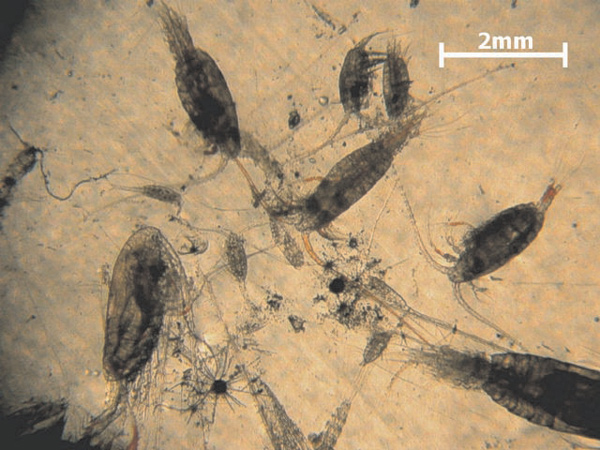
Little copepods under the microscope. Image from NOAA Ocean Explorer
While you may think these tiny creatures simply float aimlessly through the ocean, they actually control their movement within the water column. Zooplankton follow a vertical migration pattern where they stay near the bottom during the day to avoid getting eaten by fish higher in the water column. Then at night they move up toward the surface where they are able to feed and are protected from predators by the darkness. To investigate how many and which types of zooplankton are showing this migration pattern on the reef, I constructed demersal zooplankton traps to collect them. The traps will be assembled over three different substrates around the habitat to test any differences between sand, live algae, and coral/sponge coverage for zooplankton patterns. At dusk, the traps will be assembled and any zooplankton that move up will get caught in the jar attached to the top. In the morning the aquanauts will swim and collect all of the jars and preserve the samples.
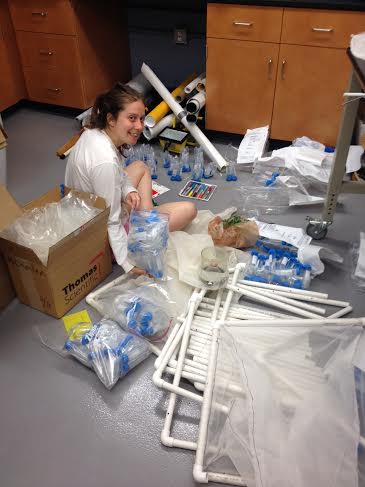
Working on labeling zooplankton sample storage containers and building plankton traps (bottom right hand corner)
To investigate zooplankton on the reef during the day, the aquanauts will swim in the afternoon over a 50m plankton net at three different heights. This will allow for a comparison between zooplankton found during the day and at night on the reef. Additionally, when Northeastern arrives at Aquarius we will incorporate vertical tows which will allow us to get a sample containing all of the zooplankton in a water column at once as well as doing tows from the boat at the surface.
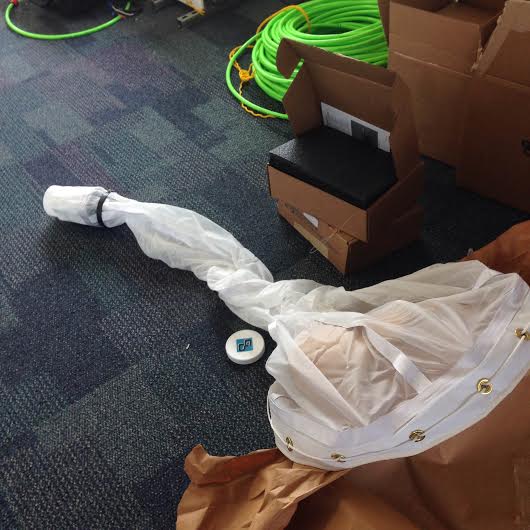
Plankton net used for daily plankton tows (Thanks Grace Young for assembling!)
I then get to identify and quantify the zooplankton in each of the samples after the mission is complete. I am very excited to have this widespread dataset to begin better understanding zooplankton dynamics on this reef. I then hope to continue similar experiments on a few other reefs to learn more about what specific factors result in zooplankton dynamics on reefs, and how feasible it is for them to be a true recovery mechanism from coral bleaching.
-Amanda
-Amanda
